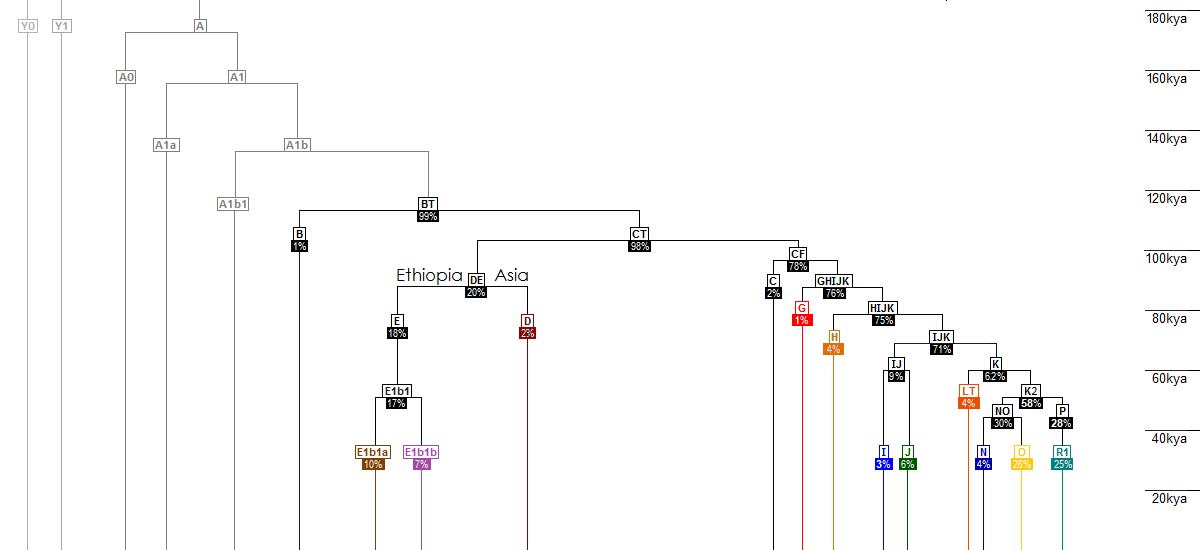
World Y-DNA frequencies

Neohumanid mutative history

Y- Population tree

Neomhumanid mutative history

  • A0 (V148) Differentiated +140kya, represented at least 3 distantly related clusters.  Survived by less than 1 Million humans in West Africa
  • A1 (L985) A steep split that distinguishes most humans, including the various Paleo African lineages from the A0 (V148) population
    • A1a (V4) An +100ky old mutation, represented by less than 1 Million humans surviving in West Africa
    • A1b (V221) This mutation distinguishes a male from all his contemporaries by fathering the absolute majority of modern humans
      • A1b1 (L419) This lineage accounts for more than 10 Million humans outside BT (M42)
        • A1b1a (V50) Emerged at +70kya this lineage survives as a minority in Namibia, substratum of click speakers
        • A1b1b (M32) This population was supreme in vast parts of Africa, prior to the E (M96) conquest of Africa
          • A1b1b1 (M28) survived by a very small minority in the HOA, stripped of females & territory by E (M96) 
          • A1b1b2 (M144) This +60ky old lineages remained dominant in large parts of Subsaharan Africa until the Mesolithic
            • A1b1b2a (M51)  conquered A1b1a (V50) territory, becoming the dominant lineage in the Mesolithic
            • A1b1b2b (M13) The most formidable Paleo-African lineage, predominant in South Sudan with lineal roots as far as 100kya
      • A1b2 (M91) aka BT (M42) This mutation distinguishes the male ancestor of +99% of human
        • B (M60) The signature of the A1b2 (M91) population that remained in Africa
          • B1 (M236) This population started moving west, possibly attracted by the presence of A0 (V148)
            • B1a (M146) This population was all but wiped out during the E (M96) episodes of violence in Western Africa
          • B2 (M182) +60kya shared & competed over Tropical Africa with other Paleo-Africans
            • B2a (M150) this population was well established all over East Africa until the E (M96) Expansion
            • B2b (M112) in Central Africa was separated from B2a by powerful A1b1 (L149) populations, living on their East
        • CT (M168) The out of Africa marker & the lineage of +99% of humans
          • CF (P143) at +60kya, the father of +80% of humanity came out of this lineage, it began an expansion out of Central Asia
            • C (M130) About 3% of humans descend from this lineage most of them live in China, Korea & Central Asia
            • F (M89) emerged 50kya, accounts for the majority of humans in all continents but Africa
              • F* This loose grouping includes more than 10 clusters in Eurasia, with a common ancestor that lived around 40kya
              • F1 (P91) This population more than likely crossed into Sri Lanka +20,000years ago
              • F2 (M427) This population crossed the Mekong river +25,000years ago
              • F3 (P96) Found primarily in the Anatolian-Iranian Plateau, with small clusters in Eurasia
              • F4 (M481) Emerged in India more +35,000years ago
              • H (M69) The Paleolithic marker of expansion in India
                • H1 (M52) Competed with the earlier DE (M1) natives.  Remained predominant in India until the arrival of the Eurasids
          • DE (M1) Spread along the coasts of South Asia, out of this lineage came the E (M96) conquerors of Africa
            • DE* (M1)  Including 3 distantly related clusters that still survive in Syria, ancestral lineages to E in Africa & D in Tibet
            • D (M174) populated the South Asian region to the West & South of the Himalayas foothills, survives in the Andaman isles, Tibet & Japan 
            • E (M96) The African reconquest marker, this lineage is the most predominant in Africa today
              • E1 (P147) This population produced lineages that account for +90% of E (M96)
              • E2 (M75) This population expanded around the same time frame as E1 (P147), possibly expanded from West Africa into the Great lakes
                • E2* Present as an ancestral lineage in 2 clusters; in Senegambia, the Great Lakes & a reduced lineage in Namibia
                • E2a (M41) An important population in the Great lakes & a minority in the Upper Nile
                • E2b (M54) Shared the same habitat with E2a (M41) in the Paleolithic
                  • E2b1 (M85) This lineage marks the southwards movement into the Great Lakes & Southwest African coastline
                    • E2b1* Clusters representing ancestral lineages & reduced population
                    • E2b1a (M200) A minority lineage in the Western parts of the Great Lakes region