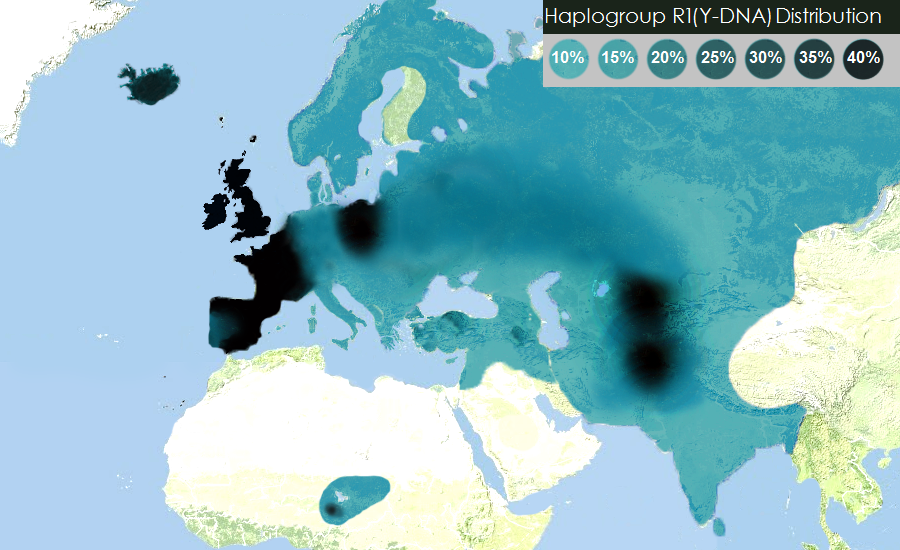
World Y-DNA frequencies
Neohumanid mutative history
Y- Population tree
R1 (M173) The marker of the emergence of Asiatic hordes in Central Asia
R1 (L62) Emergence in the Asiatics that lived on the foothills of the Anatolian-Iranian Plateau
R1 (L62*) Very small minorities found in the Anatolian-Iranian Plateau
R1 (L120) The most prominent lineage within (L62)
R1 (L120*) A small minority composed of distantly related lineages in Anatolia & Caucasus
R1 (M17) From this lineage descends the most important male in the (L62) population, accounting for +95% of the population
R1 (L417) Accounts for +90% of (L62)
R1 (Z645) This lineage includes the populations that strongly favored Balto-Slavic in Europe & Indo-Iranian in Asia
R1 (Z283) This lineage is almost exclusive to Europe, with Baltic & Slavic populations
R1 (M458) A clearly Balto-Slavic lineage
R1 (L260) This population largely West Slavic lineage
R1 (Z280) A Balto-Slavic lineage that overlaps with (M458) in Poland
R1 (L365) This population is found in Poland
R1 (Z284) This lineage emerged in Norway, expanded with the Vikings
R1 (Z93) Founder of this lineage produced a population that played the primary role in the spread of the Indo-Iranian languages
R1 (M434) This population emerged in populations associated with Pakistan
R1 (L664) Represents a Neolithic expansion into the lowland Germanic regions
R1 (M343) The Western clade of R1 (M173), although it shares Asian origins with (L62). It kept a generally Western distribution from an (L62) POV
R1 (P25) This mutation is at least 5ky after M343 restricting R1b to the sole lineage
R1 (P297) The most successful lineage in R1b, possibly emerged in the North Caspian region
R1 (M73) The population that headed East, found today as a minority lineage in Central Asia, Turkic tribes & Pakistani Hazara
R1 (M269) A very dominant population that started establishing itself in the Pontic in the Mesolithic age
R1 (L23) This lineage narrows down to the population that crossed the Pontic steppes into Europe in the Neolithic
R1 (L150) The invasion reaches the mouth of the Danube, they encounter a mixed population of Neolithic farmers & Paleolithic Europids
R1 (L51) R1b moves deeper into Europe with ease, using their neolithic militaristic superiority against the native Europid population
R1 (P310) This lineage represents the R1 (M173) Eurasid conquest of the European heartland, by 2500 BC
R1 (U106) This lineage splits from the main (P310) horde and absorbs Paleolithic Europids while moving into Germany
R1 (Z18) The western most population of U106, this lineage was founded by a Germanic speaking ancestor
R1 (Z381) The most important subgroup of U106, all members descended from a Germanic speaking ancestor
R1 (M467) Anglo-Saxon marker in the British isles, North German distribution in Europe
R1 (L1) West Germanic marker in the British isles, West European distribution in Europe
R1 (L48) Germanic marker in the British isles,
R1 (P312) The primary Indo-European population of Bronze age Europe, representing the Lineal Celts.
R1 (M65) A clearly reduced Ibero-Celtic lineage.
R1 (Z196) Most important Ibero-Celtic lineage, influenced the Nordic bronze age & experienced a Nordic revival
R1 (M153) An Ibero-Celtic lineage, found in Basques
R1 (L176.2) This population expanded out of Iberia & participated in the Nordic Bronze age
R1 (M167) A sizable minority in Catalan & Basques.
R1 (L165) An Ibero-Celtic expansion episode, settled
Scandinavia during the Nordic bronze age
R1 (U152) Gallo-Celtic lineage. The Italic Indo-Euro branch branched out of this lineage in Italy
R1 (L21) British-Celtic lineage. Remains the predominant lineage of Ireland & primary in Britain
R1 (M37) An Australian private lineage with Celtic roots
R1 (M222) Celtic lineage common in Ireland
R1 (L513) Pan-British Celtic lineage
R1 (L96) A reduced Celtic lineage that possibly emerged in Atlantic France
R1 (L144) A Celtic lineage common in Ireland
R1 (L159.2) A Celtic British lineage, that was linguistically subjugated by the Anglo-Saxon invaders
R1 (Z253) A Celtic lineage common in Ireland
R1 (DF21) Pan-British Celtic lineage
R1 (L371) The Celtic lineage common in Wales
R1 (L238) Nord-Celtic lineage. This population possibly played a role in the Nordic bronze age
R1 (DF19) German-Celtic lineage, this lineage shared the same habitat with Germanic (U106)
R1 (L584) An Anatolian branch that is found in Armenians, Assyrians & other Anatolian populations
R1 (M335) Rarely encountered population, remnants of a Paleolithic reduced lineage in Anatolia
R1 (V88) This mutation defines all R1b lineages that had an R1b ancestor in Africa
R1 (V88*) Accounting for more than one cluster, the most prominent is in North Cameroon.
R1 (M18) This population migrated from Sub-Saharan Africa to the Levant. Spread by the Ancient Phoenicians to Sardinia
R1 (V69) A Neolithic downstream of V88, most common in Northern Cameroon